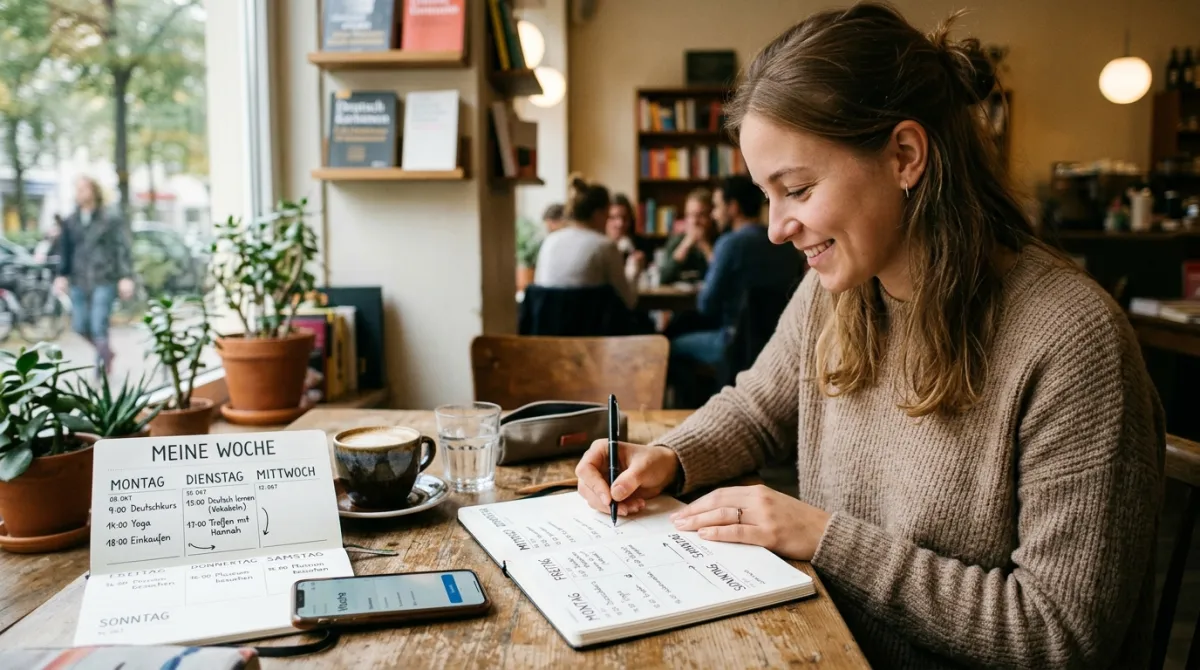
In short: knowing the days of the week is essential.
This article covers the seven days of the week in German, their meanings, origins, and pronunciation.
Montag (Monday)
Mon.tag, meaning "Mon.day" in German, marks the start of the week for work or school, as with most but not all cultures. The German pronunciation is "mohn-tahk," with emphasis on the first syllable. The -g at the end is hardened to a -k as -g normally is.
The word Montag is derived from the German word "Mond," which means "moon." In English, Monday also means "moon day."
As we work through the days of the week in German, you will see that many of the days of the week share roots with the English equivalent days.
Dienstag (Tuesday)
Dienstag, which means "Tuesday" in German, is pronounced as "dee-en-stark." Dienstag originates from an old Germanic God named Tyr, who was associated with Mars, the Roman god of war. In English, "Tuesday" is also linked to this God, who we call Tiw, so it's "Tiw's day." How Tyr becamse Dien that's for linguists to find out. The T > D transition is called the consonant shift and can be observed in many other German words like "der" = "the" or "Tür" = "door".
Mittwoch (Wednesday)
Mittwoch, meaning "Wednesday" in German, is pronounced as "mit-vokh (with a soft kh)." Note that, unlike the other days of the week, Mittwoch doesn't end with "-tag" but rather with "-woch," which means "week." This is because Mittwoch means "mid-week," reflecting Wednesday's place in the weekly cycle.
Donnerstag (Thursday)
Donnerstag, meaning "Thursday" in German, is pronounced as "don-er-stark." In the German language, Donar is the name for the Norse God of Thunder. The English word "Thursday" also comes from the God of Thunder, Thor, so it is "Thor's day." Here's the law in English translation.
Freitag (Friday)
Freitag, the German word for "Friday," is pronounced as "fry-tahk" and has got nothing to do with being "frei" (=free) even though the Friday afternoon is usually associated with being free for the weekend. Freitag comes from the Norse Goddess Frigg, also known as Freya. She was associated with various aspects such as fertility, marriage, and home. The English word "Friday" also comes from Frigg, or Freya, so it is "Frigg's day."
Samstag (Saturday)
Samstag, the German word for "Saturday," is pronounced as "zahm-stark." In northern and western Germany, you may also come across the term Sonnabend (Sunday's eve) for Saturday.
Samstag originates from the hebrew "sabbath," The French say "samedi" for saturday. It's not unusual to see the "b" in sabbath turn into an "m" in German. Think "lamb" = Lamm (n), or "comb" where the b is not pronounced = Kamm (m).
Here, German and English part ways, as the English "Saturday" comes from the Roman God Saturn who is the god of... na? what's his Fachgebiet?
Sonntag (Sunday)
Sonntag, the German word for "Sunday," is pronounced as "zon-tahk." Sonntag translates to "sun-day," which is the same as the etymology for the English "Sunday."
In many cultures, Sunday is considered a day of rest and religious observance. Most Germans do not work on Sundays. Therefore shops are also usually closed on Sundays.
Gender of the Days of the Week and Corresponding Articles
All of the days of the week in German are masculine, which means that they all take the masculine articles der/den/dem ("the") and ein/en/em ("a").
Note that this is usually if the word is standing on its own. As with English, the article is often not present in full sentences.
If you remember that the German word der Tag ("the day") is masculine, you should remember that the days of the week are masculine: Ich gehe (am) Samstag ins Kino. Wo warst du Freitag?
Most compound words in German take the gender of the word at the end. In case of Tag (m) that means any word ending in -tag are clearly masculine. Mitt.woch , however is also (m) and is clearly an exception to the rule and needs to be learned by heart. It should be (f) due to "Woche" being (f), but the cut-off -e is an exception.
Prepositions for Indicating Specific Days and Time Periods
In German, specific prepositions are used to indicate different days and time periods. The preposition am is used to indicate a specific day, such as am Montag ("on Monday") or am Samstag ("on Saturday"). am is short for an dem and pros will recognize this instantly as Dativ. Why that is nobody knows but as a rule of thumb remember: information about time WITH a preposition is always in the Dativ: am Mittwoch, in einer Woche, vor einem Monat, seit zwei Tagen etc. And information about time WITHOUT a preposition is always in the Akkusativ: Ich lerne eine Stunde Deutsch am Tag, (Einen) schönen Tag noch, Schönes Wochenende, Gute Nacht etc.
For time periods, the preposition in is used, for example, in der Woche ("during the week") or im Jahr ("in the year"). Ich komme "in einer Stunde" means I'll be there in an hour from now, so literally: with.in the hour.
The German preposition von is used to indicate "from" and bis indicates "to," as in von Montag bis Freitag ("from Monday to Friday"). This is usually used with Öffnungszeiten.
Capitalization Rules for the Days of the Week
In German, there are specific capitalization rules for the days of the week. The days of the week are capitalized since they are considered proper nouns.
However, when these days are used in a general sense, without referring to a specific day, they are written in lowercase. For example, Ich arbeite montags ("I work on Mondays"). A hint is the -s at the end which is not the plural. The proper plural for Montag would be Montage like "ein Tag, zwei Tage"
Tips for Learning and Practicing the German Days of the Week
Learning the German days of the week is straightforward. Many are similar to English (Montag, Donnerstag, Freitag, Sonntag). Remember Dienst.tag as the day every German is on duty. Mittwoch is a no-brainer I hope and Samstag is easiest remember after you have read or watched "Eine Woche voller Samstage"
Frequently Asked Questions
Below are some frequently asked questions on the days of the week in German.
What are the 7 days of the week in German?
The seven days of the week in German are
Montag - Monday - "moon day"
Dienstag - Tuesday - "tyrs = mars day"
Mittwoch - Wednesday - "middle of the week"
Donnerstag - Thursday - "thor's day = thunder day"
Freitag - Friday - "freya (Odins main wife, Queen of Asgard, goddess of marriage, motherhood, and foreknowledge)
Samstag - Saturday - "shabbat"
Sonntag - Sunday - "the sun was one of the first if not the first "God" humans ever worshipped so it deserves a day, don't you think?"
Why does the German week start on Monday?
The German week starting on Monday is influenced by cultural and historical factors. While the seven-day week has roots in various ancient civilizations, including those with religious or astrological significance, the modern convention of starting the week on Monday is prevalent in many German-speaking cultures. In semitic cultures the weekend is on Friday and Saturday while the work week starts on Sunday which must make cross cultural business quite challenging.
Why is Wednesday called Mittwoch in German?
Wednesday is called Mittwoch in German because it literally translates to "mid-week." Unlike the other days of the week, which end with -tag meaning "day," Mittwoch ends with -woch meaning "week" while still maintaining the (m) gender. This unique naming reflects the position of Wednesday as the midpoint of the week, dividing it into two equal halves.
Those that can count will quickly realize that Wednesday is the third day of the work-week and if that's the middle of the week that week should end on a Friday. I guess we took that from the Judäo-Christian tradition where the week starts on a Sunday counting as follows:
Sonntag (1), Montag (2), Dienstag (3), Mittwoch (4), Donnerstag (5), Freitag (6), Samstag (7). But for whatever reason the business world does not honor those traditions it seems.
Summing Up: All Days of the Week in German - From Montag to Sonntag
The German week runs from Montag (Monday) to Sonntag (Sunday):
Montag, Dienstag, Mittwoch, Donnerstag, Freitag, Samstag, Sonntag
The tricky ones are Dienstag, Donnerstag, Samstag/Sonnabend, and Sonntag due to their similarity. But once you know about their origin, you won't mix them up any more.
Remember: in German, days are always capitalized.